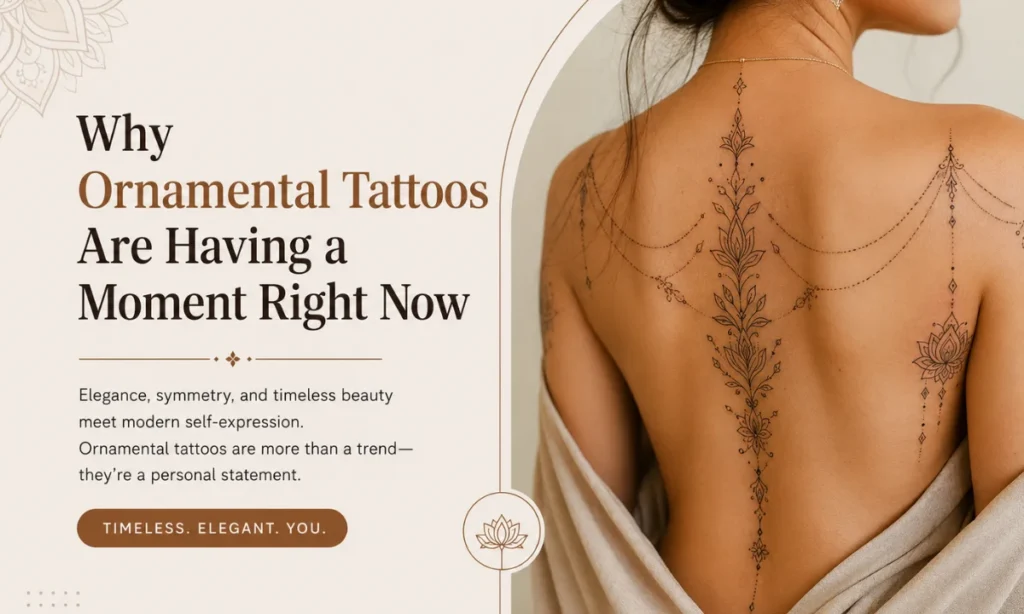
Tattoo trends come and go, but some styles manage to feel both contemporary and timeless. Ornamental tattoos are one of them. With delicate linework, intricate patterns, symmetry, geometric details, and jewelry-inspired compositions, ornamental tattooing has become increasingly popular among people looking for body art that feels elegant, artistic, and personal.
In 2026, ornamental tattoos are appearing more frequently in tattoo trend conversations, with fine lines, pointillism, decorative patterns, and designs that follow the body’s natural contours becoming especially noticeable.
But why are ornamental tattoos having such a moment right now? The answer lies in their versatility. They can be minimal or highly detailed, subtle or dramatic, symbolic or purely decorative. Most importantly, they are designed to work with the body rather than simply sit on it.
What Are Ornamental Tattoos?
An ornamental tattoo is a decorative tattoo style built around patterns, symmetry, fine linework, geometry, repetition, and carefully placed details. Unlike a realistic portrait or a traditional tattoo that may focus on a specific subject, ornamental tattoos often focus on how the design looks as a whole.
Think of the visual language of jewelry, lace, architecture, mandalas, filigree, floral patterns, and decorative artwork translated onto the skin.
The style can include elements such as:
- Mandalas
- Geometric patterns
- Floral motifs
- Filigree
- Lace-inspired designs
- Dotwork
- Decorative bands
- Jewelry-inspired compositions
- Symmetrical chest and sternum designs
- Mehndi-inspired patterns
The result can look like permanent jewelry or an intricate piece of decorative artwork.
Why Are Ornamental Tattoos Trending?
One major reason for the popularity of ornamental tattoos is their ability to combine modern tattoo aesthetics with traditional decorative art.
Current tattoo trends increasingly favor designs that feel intentional and personalized rather than simply following a popular flash design. Ornamental tattoos offer plenty of room for customization while maintaining a recognizable visual style.
They also photograph beautifully. Intricate patterns, clean lines, symmetry, and negative space can make ornamental tattoos particularly eye-catching in tattoo portfolios and social media feeds.
However, their popularity isn’t only driven by social media. The style also fits the broader interest in craftsmanship, personalization, and body adornment.
The Victoria and Albert Museum has explored the relationship between tattoos, jewelry, and ornament, noting that both forms share a long-standing desire to decorate the body.
The Influence of Jewelry on Ornamental Tattoos =h2
One of the most appealing aspects of ornamental tattooing is its connection to jewelry.
A tattoo artist can create a design that looks like a bracelet around the wrist, a necklace across the chest, a pendant on the sternum, or decorative jewelry extending along the collarbone.
This creates an interesting alternative to traditional accessories. Instead of changing jewelry according to an outfit, the tattoo itself becomes a permanent part of the wearer’s style.
Jewelry-inspired ornamental tattoos can include chains, gemstones, filigree, beads, floral details, and symmetrical patterns. The designs can be extremely delicate or use stronger blackwork for a more dramatic appearance.
Mandalas and Geometric Ornamental Designs
Mandalas remain one of the most recognizable forms of ornamental tattooing. Their radial symmetry makes them naturally suited to the style.
Geometric ornamental tattoos can also include repeating shapes, lines, circles, triangles, stars, and other symmetrical elements. These designs can be purely aesthetic or carry personal and spiritual meaning depending on the chosen motifs.
Because geometric and mandala-inspired designs can have cultural or spiritual significance, it is important to understand the origins and meanings of specific symbols before using them. Contemporary tattoo artists and trend publications increasingly emphasize being thoughtful about culturally rooted motifs.
Ornamental Tattoos Inspired by Indian Craft
Ornamental tattooing also has interesting connections with Indian decorative traditions. Mehndi, embroidery, handloom patterns, jewelry, and other forms of Indian craftsmanship offer rich visual inspiration for tattoo artists.
In 2026, Indian craft traditions are being translated into contemporary tattoo designs, including patterns inspired by embroidery and regional textile techniques. Vogue India recently highlighted how tattoo artists are drawing from Indian craft vocabulary to create designs on skin.This makes ornamental tattooing particularly interesting for people who want a modern tattoo that still connects with traditional visual culture.
However, inspiration should be approached respectfully. If a design comes from a specific cultural, religious, or traditional practice, understanding its background can help ensure that the tattoo is meaningful rather than simply decorative.
Popular Placements for Ornamental Tattoos
Placement plays an important role in ornamental tattooing because the design is often created around the body’s natural shape.
Sternum Tattoos
The sternum is one of the most popular placements for ornamental tattoos. Its central position allows artists to create symmetrical designs that radiate outward.
Collarbone Tattoos
Ornamental patterns can follow the natural curve of the collarbone, creating an elegant jewelry-like appearance.
Wrist and Forearm
Small ornamental bands can look like permanent bracelets or cuffs. Larger designs can extend from the wrist toward the forearm.
Back Tattoos
The back provides a large canvas for detailed ornamental compositions. Symmetrical designs can follow the spine and expand toward the shoulders.
Thigh Tattoos
The broad surface of the thigh allows artists to create larger decorative patterns with more detail and negative space.
Shoulder Tattoos
Ornamental designs can be shaped around the shoulder, creating a flowing transition between the upper arm, shoulder, and back.
Why Fine Line and Dotwork Work So Well
Fine linework is an important part of many ornamental tattoos. Thin lines allow artists to create intricate patterns without making the design appear too heavy.
Dotwork can then be used to create shading, texture, and depth. Instead of relying on large areas of solid black, artists can gradually build tones using carefully placed dots.
This combination creates a refined appearance that works especially well with mandalas, lace patterns, geometric compositions, and jewelry-inspired designs.
However, extremely detailed tattoos require an experienced artist. Tiny details need sufficient spacing and appropriate line weights so that the design remains visually clear as it ages.
Are Ornamental Tattoos Meaningful?
They can be.
Not every tattoo needs to have a deep symbolic meaning. Some people choose ornamental tattoos simply because they love the visual style. Others incorporate symbols, flowers, religious motifs, geometric forms, or personal elements to give the design a deeper significance.
For example, floral elements can represent growth or beauty, while geometric compositions may represent balance or order. But meanings vary depending on the specific culture, symbol, and personal interpretation.
The most important thing is that the design feels right for the person wearing it.
Choosing the Right Ornamental Tattoo Artist
Ornamental tattooing requires precision. Before booking an appointment, look at an artist’s portfolio rather than choosing a studio based only on general reviews.
Pay attention to:
- Line quality
- Symmetry
- Dotwork consistency
- Detail and spacing
- Body-flow and placement
- Healed tattoo examples
- Experience with ornamental designs
A good ornamental tattoo artist should be able to adapt a design to your anatomy rather than simply copy an image onto your skin.
Final Thoughts
The growing popularity of ornamental tattoos is not difficult to understand. They combine craftsmanship, personal expression, fashion, geometry, and traditional decorative influences in a single tattoo style.
From delicate wrist bands and fine-line floral patterns to dramatic sternum pieces and large geometric back tattoos, ornamental designs offer almost unlimited creative possibilities.
Their current popularity may be a trend, but the principles behind ornamental art—symmetry, decoration, craftsmanship, and body adornment—have existed for centuries. That combination of timeless visual language and modern tattoo techniques is what makes ornamental tattoos so appealing right now.
If you’re considering an ornamental tattoo, focus less on simply following the latest trend and more on finding a design that complements your body, reflects your personality, and can be thoughtfully executed by an experienced tattoo artist. The best ornamental tattoo isn’t just beautiful—it should look like it belongs on you.